Espazole CAP Pack Image
Esomeprazole
20 mg
Arges Life Science Limited
Unit Price: ৳ 7.00 (6 x 10: ৳ 420.00)
Also available as:
Indications
Esomeprazole is indicated:
- To relieve from chronic heartburn symptoms and other symptoms associated with GERD
- For the healing of erosive esophagitis
- For maintenance of healing of erosive esophagitis
- In combination with amoxicillin and clarithromycin for eradication of Helicobacter pylori infection in patients with duodenal ulcer disease.
- Zollinger-Ellison Syndrome
- Acid related Dyspepsia
- Duodenal & Gastric ulcer
* রেজিস্টার্ড চিকিৎসকের পরামর্শ অনুযায়ী ঔষধ সেবন করুন
Pharmacology
Esomeprazole is a proton pump inhibitor that suppresses gastric acid secretion by specific inhibition of the H+/K+-ATPase in the gastric parietal cell. Esomeprazole (S-isomer of omeprazole) is the first single optical isomer of proton pump inhibitor, provides better acid control than racemic proton pump inhibitors.
Absorption: Esomeprazole capsules contain an enteric-coated pellet formulation of esomeprazole magnesium. After oral administration peak plasma levels (Cmax) occur at approximately 1.5 hours (Tmax). The Cmax increases proportionally when the dose is increased, and there is a three-fold increase in the area under the plasma ... Read more
Interaction
Esomeprazole is extensively metabolized in the liver by CYP2C19 and CYP3A4. In vitro and in vivo studies have shown that Esomeprazole is not likely to inhibit CYPs 1A2, 2A6, 2C9, 2D6, 2E1 and 3A4. No clinically relevant interactions with drugs metabolized by these CYP enzymes would be expected. Drug interaction studies have shown that Esomeprazole does not have any clinically significant interactions with phenytoin, warfarin, quinidine, clarithromycin or amoxicillin.
Esomeprazole may potentially interfere with CYP2C19, the major Esomeprazole metabolizing enzyme. Co-administration of Esomeprazole 30 mg and diazepam, a CYP2C19 substrate has resulted in a 45% decrease in clearance of diazepam. Increased plasma levels of diazepam have been observed 12 hours after dosing and onwards. Esomeprazole inhibits gastric acid secretion. Therefore, Esomeprazole may interfere with the absorption of drugs where gastric pH is an important determinant of bioavailability (e.g., ketoconazole, iron salts and digoxin).
Co-administration of oral contraceptives, diazepam, phenytoin, or quinidine do not seem to change the pharmacokinetic profile of Esomeprazole.
Combination Therapy with Clarithromycin: Co-administration of esomeprazole, clarithromycin, and amoxicillin has resulted in increases in the plasma levels of esomeprazole and 14-hydroxyclarithromycin.
Contraindications
Esomeprazole is contraindicated in-patient with known hypersensitivity to any of the formulation.
Side Effects
The most frequently occurring adverse events reported with Esomeprazole include headache, diarrhoea, nausea, flatulence, abdominal pain, constipation and dry mouth. There are no difference in types of related adverse events seen during maintenance treatment upto 12 months compared to short term treatment.
Pregnancy & Lactation
There are no adequate and well-controlled studies in pregnant women. Animal studies have revealed no teratogenic effects. The excretion of esomeprazole in milk has not been studied. Breast-feeding should be therefore be discontinued if the use of esomeprazole is considered essential.
Precautions & Warnings
General: Symptomatic response to therapy with esomeprazole does not preclude the presence of gastric malignancy.
Information for patients: Esomeprazole capsules should be taken at least one hour before meals. For patients who have difficulty swallowing capsules, one tablespoon of applesauce can be added to an empty bowl and the Esomeprazole capsules can be opened, and the pellets inside the capsule carefully emptied onto the applesauce. The pellets should be mixed with the applesauce and then swallowed immediately. The applesauce used should not be hot and should be soft enough to be swallowed without chewing. The pellets should not be chewed or crushed. The pellet/applesauce mixture should not be stored for future use. Antacids may be used while taking esomeprazole.
Storage conditions
Store at a temperature not exceeding 30°C in a dry place. Protect from light and moisture. Keep out of reach of children.
Chemical structures
| Molecular Formula : | C17H19N3O3S |
| Chemical Structure : | 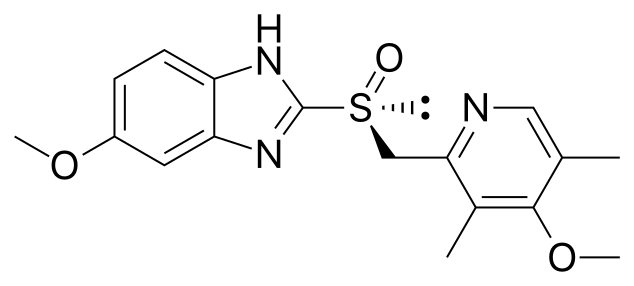 |
Common questions
What is Esomeprazole?
Esomeprazole is a proton pump inhibitor (PPI). PPIs work by reducing the amount of acid produced in the stomach. Esomeprazole is used to treat gastroesophageal reflux disease (GERD), ulcers, and other conditions that involve too much stomach acid.
What is Esomeprazole used for?
Esomeprazole has multiple uses. It eases heartburn and relieves GERD symptoms. It also aids in healing erosive esophagitis, a condition caused by stomach acid damaging the esophagus lining. Additionally, Esomeprazole effectively prevents erosive esophagitis recurrence.
What are the side effects of Esomeprazole?
Esomeprazole may cause common side effects like headaches, diarrhea, nausea, gas, stomach pain, constipation, and dry mouth. There aren't any differences in the types of side effects between long-term (up to 12 months) and short-term use.
Can I take Esomeprazole if I am pregnant or breastfeeding?
Esomeprazole doesn't have any side-effects if you are pregnant or breastfeeding. You still should talk to your doctor about the risks and benefits of taking Esomeprazole.
How long does it take for Esomeprazole to work?
Esomeprazole usually starts to work within a few hours of taking it.
Quick Tips
- Esomeprazole is a well-tolerated medicine and provides relief for a long time.
- Avoid eating late at night or before bedtime.
- Inform your doctor if you get watery diarrhea, fever or stomach pain that does not go away.
- Long-term use of Esomeprazole can cause weak bones and a deficiency of minerals such as magnesium. Take adequate dietary intake of calcium and magnesium or their supplements as prescribed by your doctor.
- Consult your doctor right away if you develop decreased urination, edema (swelling due to fluid retention), lower back pain, nausea, fatigue, and rash or fever. These could be signs of a kidney problem.
Use in Special Populations
Paediatric Use: Safety and effectiveness in paediatric patients have not been established.
Geriatric Use: No overall differences in safety and efficacy have been observed between the elderly and younger individuals, and other reported clinical experience has not identified differences in responses between the elderly and younger patients, but greater sensitivity of some older individuals cannot be ruled out
Hepatic Insufficiency: No dosage adjustment is recommended for patients with mild to moderate hepatic insufficiency. However, in patients with severe hepatic insufficiency, a dose of 20 mg once daily should not be exceeded.
Renal Insufficiency: The Pharmacokinetics of Esomeprazole in patients with renal impairment are not expected to be altered relative to healthy volunteers as less than 1% of Esomeprazole is excreted unchanged in the urine.
Overdose effects
A single oral dose of Esomeprazole at 510 mg/kg (about 103 times the human dose on a body surface area basis), has been lethal to rats. The major signs of acute toxicity are reduced motor activity, changes in respiratory frequency, tremor, ataxia, and intermittent clonic convulsions. There have been no reports of overdose with Esomeprazole. No specific antidote for Esomeprazole is known. Since Esomeprazole is extensively protein bound, it is not expected to be removed by dialysis. In the event of overdosage, treatment should be symptomatic and supportive. As with the management of any overdose, the possibility of multiple drug ingestion should be considered.
Dosage
Oral dosage form-
- Healing of Erosive Esophagitis: 20 mg or 40 mg Once Daily for 4-8 Weeks. The majority of patients are healed within 4 to 8 weeks. For patients who don't heal after 4-8 weeks, an additional 4-8 weeks of treatment may be considered. Maintenance of Healing of Erosive
- Esophagitis: 20 mg Once Daily (Clinical studies did not extend 6 months).
- Symptomatic GERD: 20 mg Once Daily for 4 Weeks. If symptoms do not resolve completely after 4 weeks, an additional 4 weeks of treatment may be considered.
- Helicobacter Pylori eradication: Triple Therapy to reduce the risk of Duodenal Ulcer recurrence-Esomeprazole 40 mg Once Daily for 10 days, Amoxicillin 1000 mg Twice Daily for 10 days, Clarithromycin 500 mg Twice Daily for 10 days.
- Zollinger-Ellison Syndrome: The dose is 20-80 mg once daily. The dosage should be adjusted individually and treatment continued as long as clinically indicated.
- Acid-related Dyspepsia: 20-40 mg once daily for 2-4 weeks according to the response.
- Duodenal ulcer: 20 mg once daily for 2-4 weeks. Gastric ulcer: 20-40 mg once daily for 4-8 weeks.
IV Injection or IV infusion:
GERD with Erosive Esophagitis-
Adult Patients (≥18 years):
- 20 mg or 40 mg once daily
- IV Injection: >3 Minutes, IV Infusion: 10-30 minutes
Pediatric Patients (1 year to 17 years)
- Body weight <55 kg: 10 mg Once daily
- Body Weight ≥55 kg: 20 once daily
- 1 month to <1 year: 0.5 mg/kg once daily
- IV Infusion: 10-30 minutes
Risk reduction of rebleeding of Gastric or Duodenal Ulcers following therapeutic endoscopy in adults-
Adult Patients (≥18 years)
- 80 mg
- IV Infusion: 30 minutes, followed by a continuous infusion of 8 mg/h for a total treatment duration of 72 hours.
Administration
Tablet or capsule: should be swallowed whole and taken one hour before a meal.
Oral Suspension: Whole contents of the packet should be taken into a small glass containing 15 ml. of water. The mixer should be stirred well and leave 2 to 3 minutes to thicken. Stir again and drink within 30 minutes. If any medicine remains after drinking, add more water, stir, and drink immediately. If the suspension is to be administered through a nasogastric or gastric tube, the volume of water in the syringe should be 15 ml. & immediately shake the syringe and leave 2 to 3 minutes to thicken. Shake the syringe and inject it through the nasogastric or gastric tube into the stomach within 30 minutes. An appropriately sized syringe should be used. Shake and flush any remaining contents from the nasogastric or gastric tube into the stomach.
IV Injection: Solution for injection is prepared by adding 5 ml of 0.9% Sodium Chloride for intravenous injection into the vial containing the dry powder. The reconstituted solution for injection is clear and colorless to very slightly yellow. IV injection must be administrated intravenously over a period of at least 3 minutes. Prepared solution must be used within 12 hours of preparation and can be exposed to normal indoor lighting at a maximum of 30°C.